Bio-based coating slow and controlled release fertilizer technology solution
Bio-based Coated Slow/Controlled-Release Fertilizer Technology
Solution Brief
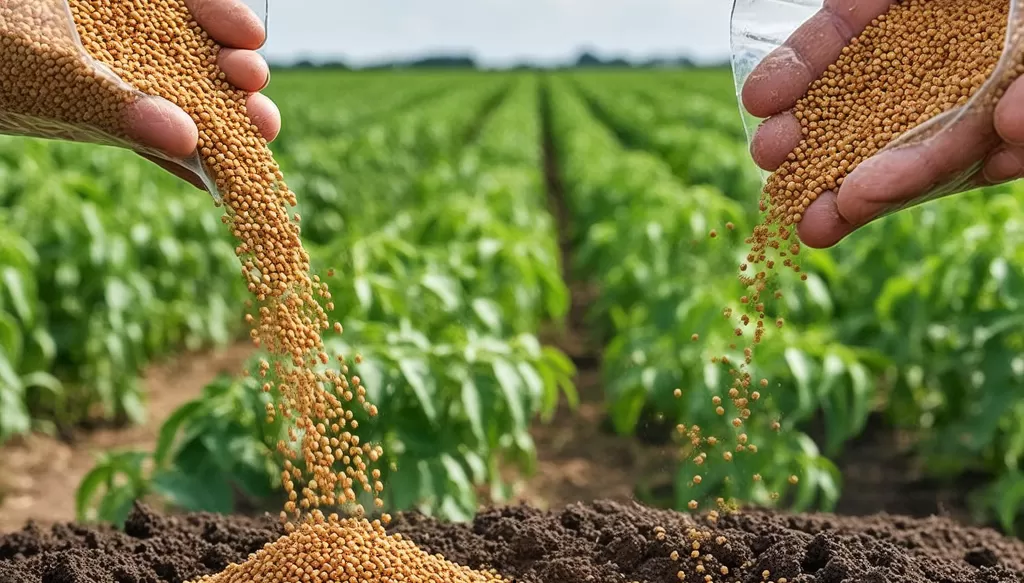
Bio-based coated slow/controlled-release fertilizer technology utilizes environmentally friendly, biodegradable coating materials to encapsulate fertilizer nutrients. This enables the nutrient release to synchronize with crop demand, allowing a single application to meet the crop's entire growth cycle requirements. It significantly improves fertilizer use efficiency, reduces environmental pollution, and promotes sustainable agricultural development.
Solution Images
Applicable Regions
This technology is suitable for regions with various global climate conditions, including low-temperature and arid areas, as well as China's major agricultural production regions.
Applicable Crops
Specialized slow/controlled-release fertilizer products have been developed for more than 10 crops, including wheat, corn, rice, garlic, bananas, and peanuts.
Solution Detailed Introduction
Technical Principle
This technology uses bio-based coating materials (such as natural plant oil derivatives from sources like resin, straw) to replace traditional petrochemical-based coatings for encapsulating fertilizer granules. This coating acts like an "intelligent switch," controlling the rate and amount of nutrient release based on soil temperature, moisture, and other conditions. This matches the nutrient release pattern with the absorption needs of crops at different growth stages, achieving "one-time fertilization, full-cycle supply."
Core Function
Its German Schnadt synergy technology 2.0 integrates three叠加 technologies: nutrient leak prevention technology, plant vaccine technology, and microbiome activation technology. This not only reduces nutrient volatilization and leaching losses, improves the soil microenvironment, and enhances fertilizer use efficiency but also enables higher crop yield and quality with less fertilizer input, reduces production costs for farmers, and minimizes the damage caused by fertilization to the soil.
Promotion Model
The technology is promoted through an integrated "government, industry, academia, research" model and shared globally using a "technology licensing + localized production + service output" approach.
Technical Highlights
- 1Eco-friendly & Biodegradable
Uses bio-based coating materials that are environmentally friendly, easily degradable, and reduce environmental pressure.
- 2Precise Nutrient Release
The coating technology precisely controls nutrient release, matching the release pattern with the absorption requirements of crops at different growth stages. Especially suitable for crops in low-temperature and arid regions.
- 3Triple Synergy Technology
Integrates German Schnadt synergy technology 2.0, featuring nutrient leak prevention, plant vaccine, and microbiome activation technologies, comprehensively enhancing fertilizer effectiveness and soil health.
- 4Breaks Technological Monopoly
Through independent innovation, it breaks the technological monopoly held by developed countries for over 50 years, achieving the "localization" and "democratization" of slow/controlled-release fertilizer technology.
Main Technical Parameters
Application Effects
Quality Improvement Description
Achieves higher crop yield and quality with less fertilizer input.
Typical Case
Qixian County Garlic Yield Increase Project, Henan
Case Brief
In May 2025, a joint yield measurement activity for slow/controlled-release fertilizer was conducted across 100 counties in Qixian County, Kaifeng City, Henan Province, an old garlic-growing area. Using slow/controlled-release fertilizer technology effectively addressed local issues such as soil compaction, frequent soil-borne diseases, small bulb size, and poor quality caused by long-term continuous monocropping, achieving significant yield increases for garlic.
Implementation Location
Duntun Village, Gaoyang Town, Qixian County, Kaifeng City, Henan Province
Implementation Effect Summary
Significant Yield Increase: The demonstration field using slow/controlled-release fertilizer achieved a yield of 5469 jin per mu, while the control field yielded 3869 jin per mu, representing a substantial increase of 1600 jin per mu.
Case Detailed Introduction
Qixian County is a famous garlic-producing region. However, long-term continuous monocropping led to prominent soil problems, severely affecting garlic yield and quality. Here, specialized slow/controlled-release fertilizer products developed for garlic were promoted, and scientific yield measurement activities were conducted. The yield measurement used a three-point sampling method to compare the yields of demonstration fields and control fields.
Case Images
User Feedback Summary
"Slow/controlled-release fertilizer can slowly release nutrients and control release precisely, ensuring the garlic receives nutrient supply throughout the entire growth cycle... It prevents excessive early growth and late-stage nutrient deficiency, laying a good foundation for high garlic yields."
—— Large-scale grower Han Lingbin
"Using slow/controlled-release fertilizer this year prevented excessive early growth and late-stage nutrient deficiency in my garlic. I am very satisfied with the yield measurement results."
—— Grower Zhu Jianyong